
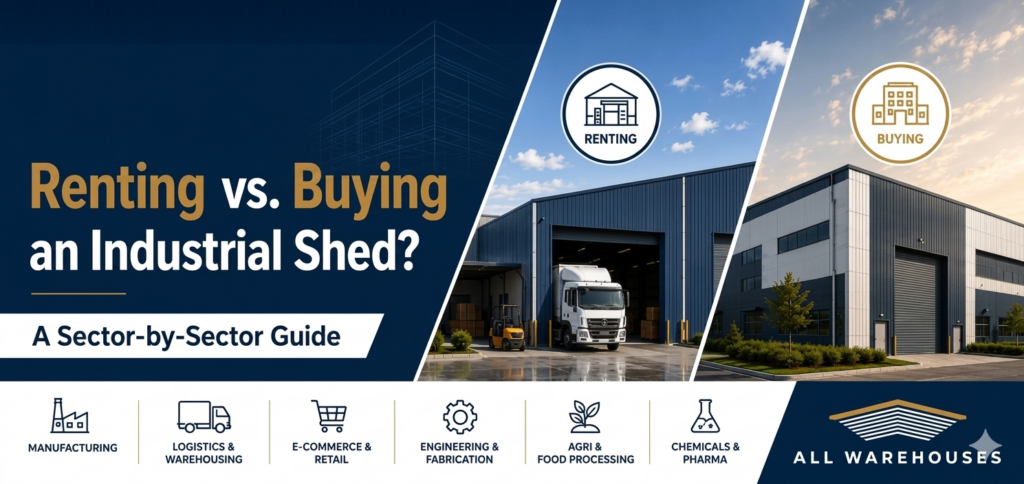
One of the most common questions in industrial real estate is deceptively simple: Should we rent or buy a facility?
The answer is not universal. It depends on the sector, the business model, the production horizon, the capital structure, and the strategic ambitions of the company.
Across India’s industrial corridors – from the automotive clusters of Chennai to the logistics hubs of Ahmedabad – patterns have emerged. Certain types of companies almost always rent, while others almost always buy. Understanding these patterns helps businesses make faster, more confident decisions when evaluating industrial sheds for rent in Chennai, factory for lease, or industrial land for sale in Chennai.
FMCG Distributors | Why They Rent
Primary need -> Flexible warehouse space positioned near consumer hubs, retail clusters, and last-mile distribution points.
Why rent -> FMCG demand is seasonal and geography-dependent. Renting a warehouse for rent in Chennai or a godown for rent in Chennai allows distributors to right-size inventory space without long-term lock-in.
Key concern -> Speed of setup and proximity to urban centres. Pre-built, compliant sheds are far preferable to greenfield development.
Pharma & Cold Storage Operators | Why They Rent
Primary need -> Temperature-controlled, compliant facilities with FSSAI and drug licence compatibility – without tying up capital in specialised real estate.
Why rent -> Cold storage warehouse and cold storage facility infrastructure is expensive to build. Renting a plug-and-play compliant facility avoids capital lock-in and keeps balance sheets light.
Key concern -> Compliance standards, power backup, and temperature zone segregation. Regulatory approvals, fire safety compliance, and operational certifications are non-negotiable for this sector.
Logistics & 3PL Firms | Why They Rent
Primary need -> Multi-corridor presence across India – Chennai, Ahmedabad, Pune, NCR – to serve pan-India clients.
Why rent -> 3PL operators expand rapidly based on client contracts, which can be 2 to 5 years.Industrial shed for rent in Ahmedabad or warehouse for rent in Chennai allows geographic flexibility without long-term property commitments.
Key concern -> Warehouse layout design, dock availability, and proximity to NH corridors. Turnaround time on site activation is critical.
Automotive Tier-2 Suppliers | Why They Rent
Primary need -> Proximity to anchor OEM plants for just-in-time delivery – Chennai’s auto corridor (Sriperumbudur, Oragadam) being a key example.
Why rent -> Tier-2 suppliers depend on OEM contracts that can change in tenure or volume. Renting an industrial shed for rent in Chennai near the OEM plant keeps supply chain proximity without long-term real estate exposure.
Key concern -> Location specificity, structural load capacity for heavy components, and quick-start capability.
COMPANIES THAT PREFER BUYING SHEDS
Large Manufacturers – Auto, Electronics, Engineering | Why They Buy
Primary need -> Long-term, purpose-built facilities with customised layouts, heavy power infrastructure, and controlled access.
Why buy -> Large manufacturers with 10 to 20 year production horizons need certainty of tenure and freedom to customise. Buying industrial land for sale in Chennai and building to specification gives them complete operational control.
Key concern -> Structural standards, HT power connectivity, clear height, and seismic safety. Industrial facility design must match production requirements exactly.
Export-Oriented Units (EOUs) | Why They Buy
Primary need -> Owned, compliance-certified facilities that meet customs, DGFT, and export zone requirements.
Why buy -> Export compliance demands facility ownership or long-term lease equivalents. EOUs invest in factory for sale or owned sheds to achieve the customisation and compliance certification that export licensing requires.
Key concern -> Zoning (SEZ or EOU designated land), land conversion approvals, planning permit, and setback compliance.
Why the Difference? The Core Logic of Rent vs. Buy
The rent-vs-buy decision in industrial real estate ultimately comes down to two fundamental variables: time horizon and operational certainty. Businesses with short or variable time horizons, or those whose space requirements are likely to change, should rent. Businesses with long, certain time horizons and stable operational profiles should buy.
RENTING: Flexibility to scale up or down, Low upfront capital outlay, Faster operational setup, Rental expenses are tax-deductible, No land ownership risk, Ideal for variable demand cycles.
BUYING: Long-term control over facility, Asset appreciation over time, Customization freedom; Eligible for depreciation benefits; Stable long-term base for operations; Ideal for fixed, long-horizon production.
There is also a capital efficiency dimension. For a company earning 20% return on invested capital, locking Rs. 10 crore into industrial land purchase has a clear opportunity cost. The same capital deployed in the core business generates far more value than the land appreciation – making renting the rational choice even if buying is affordable.
Conversely, for a company with a 25-year production mandate and a requirement for highly customised infrastructure – clean rooms, explosion-proof electrical systems, or heavy floor load capacity – buying and building to specification is the only logical path. The cost of compliance retrofitting in a rented facility would quickly exceed the cost of ownership.
Making the Right Call for Your Business
The industrial real estate market in India has matured to the point where both renting and buying offer genuine strategic value – provided the decision is made with full information. Whether you are evaluating industrial shed for rent in Chennai, scouting industrial land for sale in Chennai, assessing warehouse for rent in Chennai, or considering factory for lease options in a new corridor, the question is not which option is better in the abstract.
The question is: which option is better for your business, at this stage of growth, in this location, with this capital structure? Get that analysis right – factoring in compliance status and approvals, location, space requirements, and budget – and the decision almost always becomes clear.
If the analysis is still complex, engage land acquisition specialists and industrial property management advisors with deep local market knowledge. The cost of expert advice is a fraction of the cost of a poor industrial real estate decision – whether you are renting, buying, or selling.