
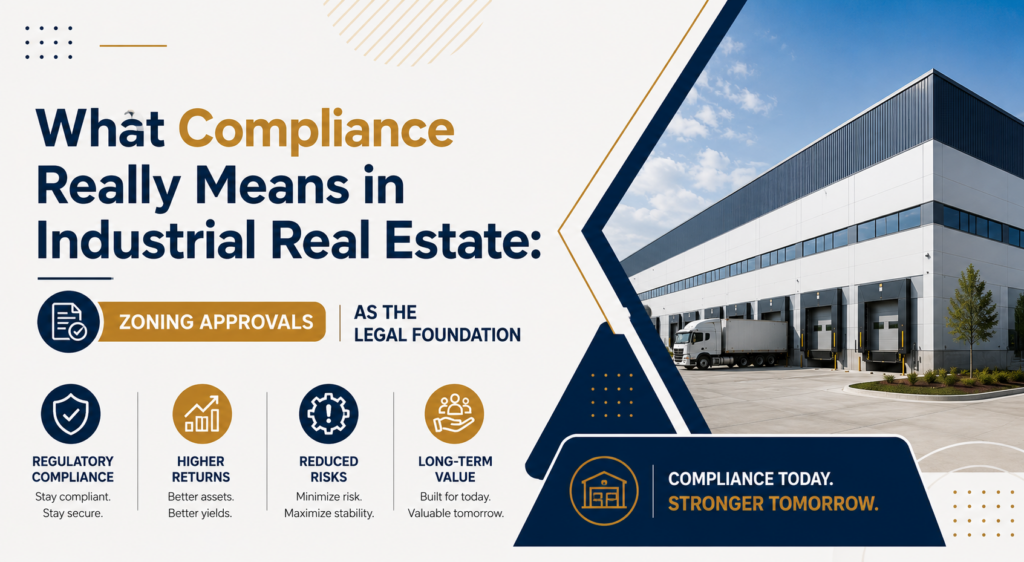
In industrial real estate,location has traditionally been the most important driver of value.Today,however,another factor is increasingly influencing tenant demand,financing access,insurance coverage and asset appreciation: compliance.As demand for industrial sheds,warehouses and manufacturing facilities continues to grow across India’s major industrial corridors,investors are recognizing that compliance is no longer just a regulatory requirement.It has become a commercial advantage that directly impacts occupancy rates,rental income,financing opportunities and long-term asset value.
Whether you are evaluating a warehouse,factory, or industrial land development opportunity, understanding the investment advantages of compliance-certified buildings is essential.Facilities that meet statutory requirements across planning approvals, environmental regulations, fire safety, structural integrity,utilities and workforce infrastructure consistently outperform non-compliant assets in the market.
1.Tenant Confidence: Quality Occupiers Prioritize Compliance
One of the biggest advantages of a compliance-certified industrial building is its ability to attract high-quality tenants.When multinational corporations, automotive suppliers,logistics operators,e-commerce companies, pharmaceutical manufacturers, or large domestic businesses evaluate a facility,compliance is one of their first considerations. Before signing a lease,their legal and operations teams conduct detailed due diligence to verify approvals,certifications and operational readiness.
They typically review:
- Land use approvals
- Building permits
- Fire NOCs
- Environmental clearances
- Structural certifications
- Utility infrastructure
- Safety compliance records
For global companies, occupying a non-compliant facility is often not an option. Many operate under strict internal health,safety and environmental policies that require every facility within their supply chain to meet defined compliance standards.This trend is no longer limited to multinational corporations.Large Indian manufacturers, third-party logistics providers, and organized warehousing operators are increasingly adopting similar standards. As a result, non-compliant facilities are finding it more difficult to attract premium occupiers.For property owners, this creates a significant advantage.Compliance-certified buildings appeal to a broader tenant base, experience lower vacancy rates, and often secure longer lease commitments from financially stable occupiers.
2. Compliance Improves Financing Opportunities
Access to capital is one of the most important considerations for industrial real estate investors and developers.Banks, financial institutions, and institutional lenders carefully evaluate compliance before approving loans against industrial assets. Whether financing a warehouse development, purchasing an industrial property, or refinancing an existing facility,lenders require clear documentation demonstrating that the property complies with applicable regulations.
- Approved building plans
- Land use permissions
- Fire safety approvals
- Environmental clearances
- Structural certifications
- Utility approvals
Typically, lenders review:
The reason is straightforward. Non-compliant assets carry higher regulatory risk. If authorities identify serious violations,operations may be restricted or suspended, directly affecting the property’s value and the lender’s security.
Compliance-certified assets, on the other hand, are viewed as lower-risk investments. This often translates into:
- Easier loan approvals
- Faster financing processes
- Better lending terms
- Improved refinancing opportunities
For developers,integrating compliance requirements from the planning stage can prevent costly delays and ensure smoother project execution.
3. Better Insurance Coverage and Lower Risk Exposure
Insurance providers assess risk in much the same way as lenders.Industrial facilities that fail to meet regulatory requirements may face higher insurance premiums, restricted coverage, or even difficulty obtaining insurance altogether.
Insurers typically examine:
- Fire protection systems
- Building safety standards
- Structural stability
- Environmental compliance
- Operational risk management
For example,a warehouse lacking adequate fire protection infrastructure may struggle to obtain comprehensive fire and property insurance coverage. Similarly,facilities with unresolved compliance issues may face limitations under business interruption policies.
Compliance-certified buildings generally benefit from:
- Broader insurance coverage
- Lower premium costs
- Faster claim processing
- Reduced operational risk
This creates value not only for property owners but also for tenants, who gain greater confidence in the reliability and security of the facility.
4. Stronger Long-Term Returns on Investment
Perhaps the most compelling argument for compliance is its impact on long-term returns.Non-compliant properties are exposed to a variety of risks that can negatively affect rental income and asset value, including:
Regulatory Actions
Authorities may issue notices,impose penalties (or) suspend operations if critical approvals are missing or expired.
Tenant Turnover
Many occupiers conduct regular compliance audits. Facilities that fail these assessments risk losing tenants, resulting in vacancy periods and revenue loss.
Costly Retrofitting
Addressing compliance deficiencies after occupancy is often expensive and disruptive. In some cases, modifications may require major structural changes.
Rental Discounts
Tenants frequently negotiate lower rents when they perceive compliance-related risks.
By contrast, compliance-certified facilities typically achieve:
- Higher occupancy levels
- Longer lease terms
- Improved tenant retention
- Premium rental rates
Consider two similar industrial facilities in the same market. If one achieves even a 10% rental premium due to stronger compliance credentials, the additional income generated over a long-term lease can significantly exceed the original compliance investment.In many cases,compliance becomes one of the highest-return investments made during the development process.
5. Compliance Enhances Resale Value
Industrial real estate is increasingly attracting institutional investors,private equity firms and long-term asset managers.
These investors apply rigorous due diligence standards before acquiring industrial properties.
When evaluating a facility,buyers typically review:
1.Planning approvals
2.Environmental clearances
3.Fire safety certifications
4.Structural documentation
5.Utility approvals
6.Occupancy-related records
Assets with complete and current compliance documentation are generally considered investment-grade properties.
These buildings often benefit from:
1.Larger buyer pools
2.Faster transaction timelines
3.Higher valuations
4.Stronger investor confidence
In contrast, non-compliant assets may be discounted heavily because buyers must account for the cost, uncertainty, and time required to address compliance deficiencies.
For developers and investors, this means that money invested in compliance during the development stage often contributes directly to future exit value.
6. The Compliance Premium Is Growing
India’s industrial real estate sector is undergoing rapid transformation.Manufacturing expansion, logistics growth, infrastructure development and global supply chain diversification are creating new opportunities across the country. At the same time,occupiers are becoming more selective about the facilities they choose.
This trend is particularly evident in industrial corridors such as:
Companies entering these markets increasingly expect facilities to meet global operating standards.As compliance expectations rise,the gap between compliant and non-compliant assets continues to widen.Property owners who invest in compliance today are positioning themselves to benefit from stronger tenant demand and greater long-term asset appreciation.
Compliance Is the New Foundation of Industrial Value
Location, connectivity, and infrastructure will always remain important drivers of industrial real estate value. However, in today’s market,compliance has become equally important.A compliance-certified building offers advantages that extend far beyond regulatory approval. It attracts better tenants, improves financing access,strengthens insurance eligibility,enhances rental performance, and supports higher resale values.For investors,developers and property owners,compliance should no longer be viewed as a cost of doing business.It should be viewed as a strategic investment that protects and enhances asset value throughout the property’s life cycle.
As industrial real estate continues to evolve,the most successful assets will not simply be those in the best locations. They will be the assets that combine location,infrastructure, and full compliance to meet the expectations of modern occupiers,lenders,insurers and investors.In today’s industrial market,compliance is not a constraint on returns-it is one of the strongest drivers of them.