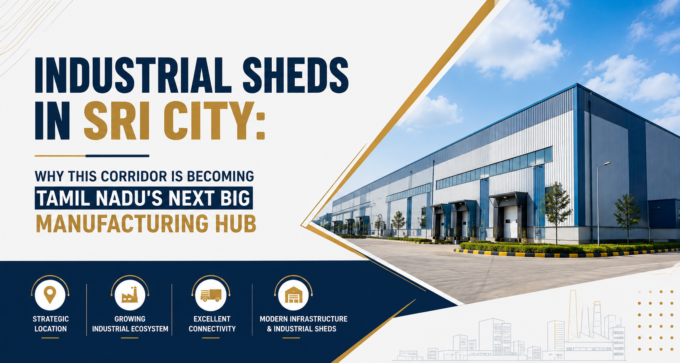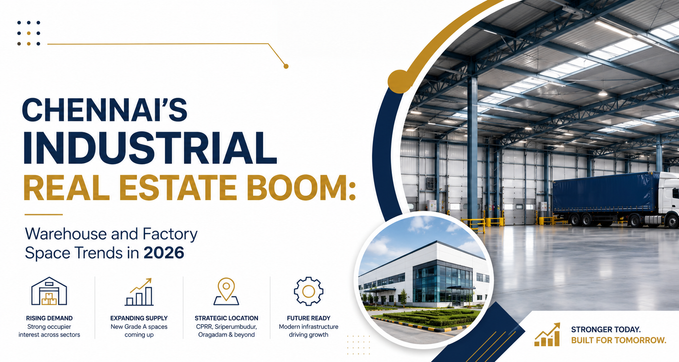

There’s a structural shift happening in Indian manufacturing right now, and Tamil Nadu is one of its biggest beneficiaries. As global electronics, auto-component, and consumer durable brands accelerate their “China+1” diversification strategy, and as Production Linked Incentive (PLI) schemes pull fresh manufacturing investment into the country, demand for factories for rent, industrial land for sale, and purpose-built industrial sheds across the state has climbed sharply. If you’ve noticed enquiries for industrial property for rent moving faster than they used to, this is why.
What’s Actually Driving the Shift
Three forces are converging at the same time, and it’s worth understanding each one separately because they’re pulling different types of occupiers into the market.
China+1 diversification. Global manufacturers — particularly in electronics assembly, precision components, and textiles — have spent the last few years actively reducing single-country concentration risk. Tamil Nadu, with its existing auto and electronics manufacturing base around Chennai, Sriperumbudur, and Hosur, has been a natural landing point. These occupiers typically need larger factory for lease commitments with high power sanctioned loads, not small speculative sheds.
PLI-linked capacity expansion. Government incentive schemes tied to domestic manufacturing output have pushed both established Indian manufacturers and new entrants to expand capacity quickly, often on tight timelines tied to scheme eligibility windows. This has created urgent demand for industrial land for rent and ready-to-occupy industrial sheds for rent — occupiers under PLI timelines frequently can’t wait for a build-to-suit facility and need existing inventory they can move into fast.
Auto sector localisation. As OEMs push suppliers to localise more of the component supply chain rather than importing, tier-1 and tier-2 auto-ancillary manufacturers are expanding their Tamil Nadu footprint aggressively, driving fresh demand for factory for rent in Chennai and the surrounding industrial belt.
Which Corridors Are Absorbing This Demand
The demand signal is live. The Centre has just approved two Electronics Manufacturing Clusters in Tamil Nadu worth ₹1,012 crore – a 474-acre cluster at Manallur and a 379-acre facility at Pillapaikkam.this sits right in the Sriperumbudur belt. Tamil Nadu has drawn ₹68,817 crore across manufacturing, AI, aerospace and semiconductors in 2026, including L&T’s ₹18,600 crore MoU and Minebea Mitsumi’s ₹1,980 crore semiconductor and precision manufacturing plan in Tiruvallur.
The Rent-vs-Buy Calculus Has Shifted
Historically, manufacturers entering a new market leaned toward leasing to limit initial capital exposure. That calculus is shifting for PLI-linked and China+1 occupiers specifically, for a simple reason: many of these investments are planned around 8-10 year capacity horizons tied to global supply chain restructuring that isn’t expected to reverse quickly. For occupiers with that kind of conviction, buying an industrial plot for sale or committing to a long industrial land for rent lease with purchase option makes more financial sense than a standard 3-year lease renewal cycle.
That said, speed still matters. Occupiers racing to hit PLI-linked capacity deadlines often can’t afford the 12-18 months a land purchase and ground-up construction typically takes. This has fuelled strong demand for existing industrial shed for sale and industrial property for sale inventory that can be occupied and fitted out quickly, even at a premium to raw land pricing.
What This Means for Existing Landlords and Developers
Developers holding industrial land for sale or completed industrial sheds in the right corridors are in a genuinely strong negotiating position right now, a reversal from the tenant-favourable market of a few years ago. Occupiers under scheme deadlines have less leverage to negotiate rent-free fit-out periods or aggressive rent escalation caps than they would have in a softer market.
This has also encouraged more speculative development — developers building industrial sheds ahead of confirmed tenants, betting that China+1 and PLI-driven demand will absorb the space quickly. So far, absorption rates have largely validated this bet in the established corridors, though it’s worth watching whether this pace holds as more supply comes online over the next 12-18 months.
The Compliance Layer Matters More Now
A wrinkle specific to this wave of demand: many PLI-linked and export-oriented manufacturers face stricter compliance requirements than a typical domestic-market tenant — environmental clearances, specific effluent treatment standards, and in some cases bonded warehouse or SEZ-adjacent status requirements. This means industrial property management and pre-clearance status of a facility has become a genuine differentiator in deal negotiations, not just a box-ticking formality. Landlords who’ve proactively secured environmental and fire clearances on their industrial shed for rent inventory are closing deals faster than those leaving it to the tenant to sort out post-signing.
What Occupiers Should Do Differently Right Now
If you’re planning a Tamil Nadu manufacturing entry or expansion tied to China+1 sourcing shifts or PLI eligibility, a few practical adjustments make sense given current market conditions:
- Move early on site selection. Prime plots in Sriperumbudur and Oragadam ,Pillaipakkalm,manalure are moving faster than they were 18 months ago, and waiting for a “better deal” can mean losing access to the corridor entirely.
- Budget more time for power sanctioning. Industrial power connections for larger manufacturing loads can take months to sanction in high-demand corridors where the local grid is already heavily subscribed.
- Get compliance clarity before committing capital. Confirm environmental and fire-NOC status of any industrial shed for rent or purchase target before signing, especially if your operations face export-linked compliance requirements.
- Consider secondary corridors seriously. Hosur and Sri City are absorbing meaningful overflow demand and, in some cases, offer faster occupancy timelines than the more congested primary corridors.
The Bigger Picture
This isn’t a short-term blip. Global supply chain diversification and India’s manufacturing incentive push are both multi-year trends, and Tamil Nadu’s existing industrial base gives it a durable advantage in capturing this demand relative to states building an industrial ecosystem from scratch. Occupiers and investors who understand this and position early — whether through factory for lease commitments, land purchase, or speculative shed development — are likely to be better positioned than those waiting for the market to cool, which doesn’t look imminent based on current absorption trends.
Frequently Asked Questions
1. Why is demand for industrial sheds in Tamil Nadu rising so quickly right now?
Three overlapping trends are driving it: global manufacturers diversifying away from single-country China exposure (“China+1”), PLI scheme-linked capacity expansion by Indian and international manufacturers, and auto OEMs pushing suppliers to localise more of the component supply chain. Together they’ve pushed demand for factories for rent and industrial land for sale well above pre-pandemic levels.
23. Which Tamil Nadu locations are best positioned for this manufacturing demand wave?
Sriperumbudur and Oragadam remain the primary corridors due to existing OEM and supplier density, but with land there thinning out, Hosur and Sri City are absorbing significant overflow demand, in some cases with faster occupancy timelines for industrial land for rent and shed leasing than the more congested established belt.
4. What compliance issues should manufacturers check before committing to a facility under PLI or export-linked requirements?
Confirm environmental clearance status, effluent treatment capacity, and fire-NOC documentation before signing, and check whether the facility or corridor has any SEZ-adjacent or bonded warehouse implications relevant to your export structure. Pre-cleared industrial sheds are closing deals faster in this cycle because compliance uncertainty has become a real deal-breaker for scheme-linked occupiers.