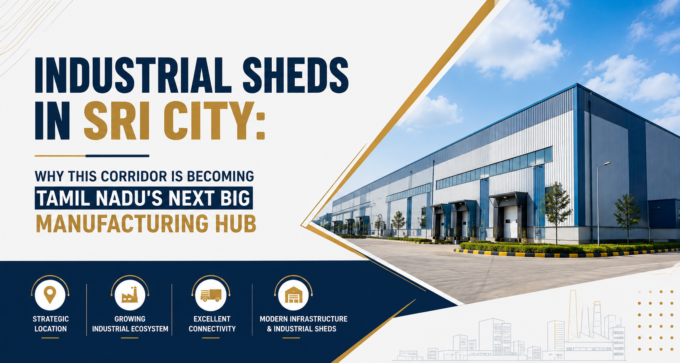
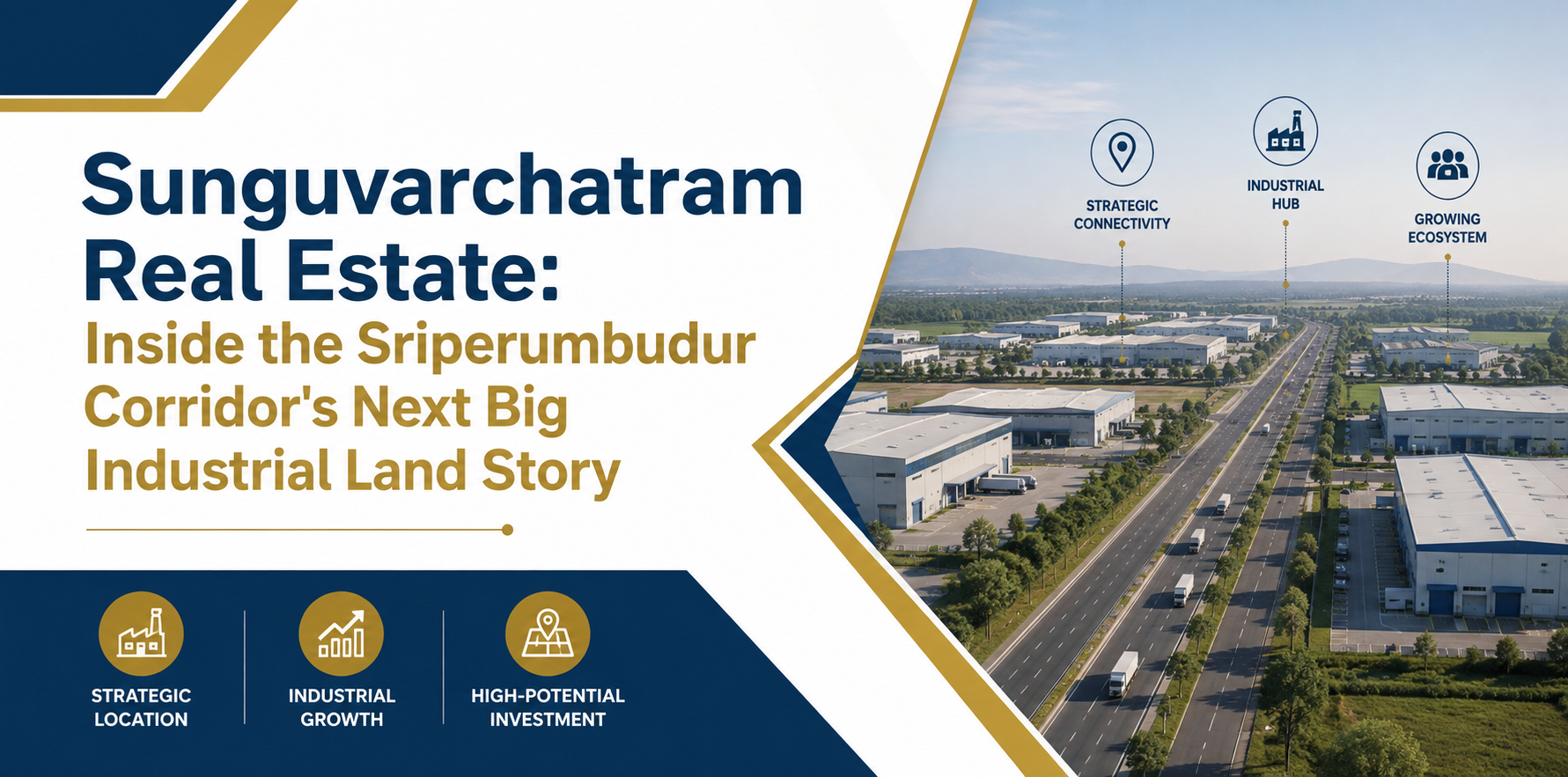
Drive twenty minutes past Sriperumbudur on the Chennai-Bangalore highway and you’ll pass a town that most people outside the industrial real estate world have never heard of, yet one that Hyundai, Foxconn, Samsung’s supplier network, and now a ₹4,000 crore industrial park developer have all bet on: Sunguvarchatram. For investors and developers tracking the Sriperumbudur-Oragadam belt, it’s quickly moving from a footnote on the map to a line item on the deal sheet.
The Industrial Base That Built the Land Story
Sunguvarchatram’s real estate relevance doesn’t exist in isolation — it’s a function of what’s already anchored a few kilometers away. The Sriperumbudur-Oragadam-Irungattukottai belt is one of India’s most mature manufacturing clusters, built around Hyundai’s automotive base and radiating outward into auto components, electronics, and engineering. Sunguvarchatram sits inside this belt geographically, with SIPCOT’s Sriperumbudur Industrial Park and SEZ, Oragadam Industrial Park, and Irungattukottai Industrial Park all within a short radius.
The town’s own industrial footprint has grown alongside this. Auto-component manufacturers like Caparo Engineering operate forging units within the local SIPCOT estate, and the broader Sriperumbudur cluster now hosts more than 50 Electronics Manufacturing Services (EMS) units, producing a meaningful share of India’s mobile phone and IT hardware output — with global names like Foxconn,salcomp,saintgobin and Samsung’s supplier ecosystem anchoring demand in the corridor. The 2025 Electronics Components Manufacturing Scheme (ECMS) is expected to pull in a further wave of component-level manufacturing rather than just final assembly, which typically means more, smaller-footprint industrial land demand rather than fewer, larger single-tenant plots.
The Land Market: What Developers Are Actually Seeing
Industrial and mixed-use land around Sunguvarchatram trades across a fairly wide band, and the spread matters more here than the headline number. As with anywhere in this corridor, the real determinant of value isn’t the headline rate — it’s road width and frontage, land classification (punjai vs. nanjai), power and water access, and whether the parcel can legally support industrial or commercial use without a lengthy conversion process.
For context, SIPCOT’s own historical land rates across its Sriperumbudur-area SEZs and industrial parks have sat meaningfully below open-market private land, which is exactly why private industrial parks they offer developer-led infrastructure and faster possession than waiting on SIPCOT allotment queues, at a price point private capital is willing to pay for speed and location.
Warehousing specifically has emerged as the strongest sub-segment in the wider Sriperumbudur belt. Leased industrial shed and warehouse space in the area has been quoted at roughly ₹29 per sq ft per month for well-specified stock with power backup, DG availability, and water storage — driven by demand from factory storage, the auto and electronics supply chain, e-commerce logistics, and third-party logistics (3PL) operators using the corridor’s highway access to serve both Chennai and the wider south.
The WS Industries Project: A Signal, Not Just a Single Deal
The clearest marker of where Sunguvarchatram sits on the corridor’s growth curve is the WS Industries India Ltd project announced in mid-2025: a planned ₹4,000 crore, 600-acre “smart industrial corridor” park, with roughly 400 acres already acquired (250 acres via a SARFAESI auction) and ₹440 crore raised through equity placement to fund the build-out. The park is being positioned for electronics, semiconductor, engineering manufacturing, warehousing, and data centers — with the company citing proximity to Foxconn and Samsung’s supplier base, quick access to the Oragadam industrial estate, connectivity to the Chennai-Bengaluru Expressway, and closeness to the upcoming Parandur international airport as the core location thesis.
For an industrial real estate audience, the size of this single project is the real story. A 600-acre private park is larger than most standalone SIPCOT estates in the state, and a developer betting ₹4,000 crore on one location is a strong signal that institutional capital sees Sunguvarchatram as a destination in its own right — not just spillover land for Sriperumbudur once SIPCOT’s own inventory runs out.
Connectivity: The Underlying Reason This Works
None of this land demand happens without infrastructure, and Sunguvarchatram’s positioning checks the boxes an industrial occupier or logistics operator actually screens for:
- Highway access: Direct frontage and proximity to NH-48, the Chennai-Bangalore corridor, keeping outbound logistics to both Chennai port and the Karnataka border efficient.
- Airport access: Roughly 35 km from Chennai’s existing airport today, with the upcoming Parandur greenfield international airport positioned to cut that further and add a second air-cargo option for the corridor.
- Anchor-cluster proximity: A 4-10 km run to Sriperumbudur , thiruvallur and short access to Oragadam keeps it inside the supplier ecosystem that auto and electronics majors depend on for just-in-time delivery.
- Power and utility infrastructure: Existing substations and industrial-grade power supply in the corridor, which large-scale electronics and semiconductor-adjacent manufacturing depends on far more heavily than traditional light manufacturing.
What This Means for Investors and Developers
The pattern across this corridor has been consistent for two decades: an anchor OEM creates land value nearby, land value pulls in SIPCOT and private industrial park development, and that development pulls warehousing, logistics, and ancillary manufacturing demand in behind it. Sriperumbudur and Oragadam both followed this exact arc, moving from agricultural villages to some of South India’s most sought-after industrial addresses. Sunguvarchatram — with its highway frontage, cluster proximity, and now a marquee private park anchoring institutional confidence — appears to be tracing the same curve, just a few years behind.
For anyone evaluating land in the corridor today, the practical takeaway is to treat Sunguvarchatram less as a cheaper alternative to Sriperumbudur and more as the corridor’s next expansion zone — where due diligence on land classification, title, and approval status matters as much as the headline price per acre, and where the WS Industries project will likely set the benchmark for how quickly the surrounding land market re-rates over the next few years.
Frequently Asked Questions
1. What does the name “Sunguvarchatram” mean?
“Chatram” comes from the Tamil word sathiram, meaning a choultry or free rest house historically built for travelers and pilgrims along trade and temple routes. “Sunguvar” most likely refers to the patron or founder who endowed the original rest house, following a naming pattern common across Tamil Nadu, though no surviving inscription confirms the exact person or date.
2. Is Sunguvarchatram part of Sriperumbudur?
Administratively, Sunguvarchatram is a separate town, but it falls within Sriperumbudur taluk in Kancheepuram district and is treated as part of the same industrial and urban cluster. It sits roughly 4-10 km from Sriperumbudur town, depending on the route taken.
3. What is industrial land currently going for in Sunguvarchatram?
Larger industrial/warehousing-classified parcels have listed in the range of roughly 1.8cr -2.5cr per acre in recent broker listings, Rates vary widely based on road width, frontage, land classification, and utility access, so headline per-acre figures should always be verified against the specific parcel’s approvals and title status.
4. What industries are located in and around Sunguvarchatram?
The town sits within the Sriperumbudur-Oragadam industrial belt, known for automotive and auto-component manufacturing (anchored by the nearby Hyundai cluster) and a dense concentration of Electronics Manufacturing Services (EMS) units producing mobile phones and IT hardware, with proximity to major players like Foxconn and Samsung’s supplier network. Engineering, semiconductor-linked manufacturing, and warehousing/logistics are the fastest-growing segments.
5. What is the WS Industries industrial park in Sunguvarchatram?
Announced in June 2025, it’s a planned ₹4,000 crore, 600-acre “smart industrial corridor” project by WS Industries India Ltd, with roughly 400 acres already acquired (partly via a SARFAESI auction) and ₹440 crore raised through equity placement. It’s designed for electronics, semiconductor, engineering manufacturing, warehousing, and data centers, and is projected to create around 14,000 jobs.
6. Why is Sunguvarchatram attracting industrial real estate investment now?
Its direct NH-48 access, proximity to the established
Sriperumbudur-Oragadam-Irungattukottai manufacturing base, closeness to the upcoming Parandur international airport, and India’s broader “China+1” electronics diversification push (supported by schemes like the 2025 Electronics Components Manufacturing Scheme) have combined to make it an attractive site for large-scale industrial parks, warehousing, and EMS expansion over the past two to three years.