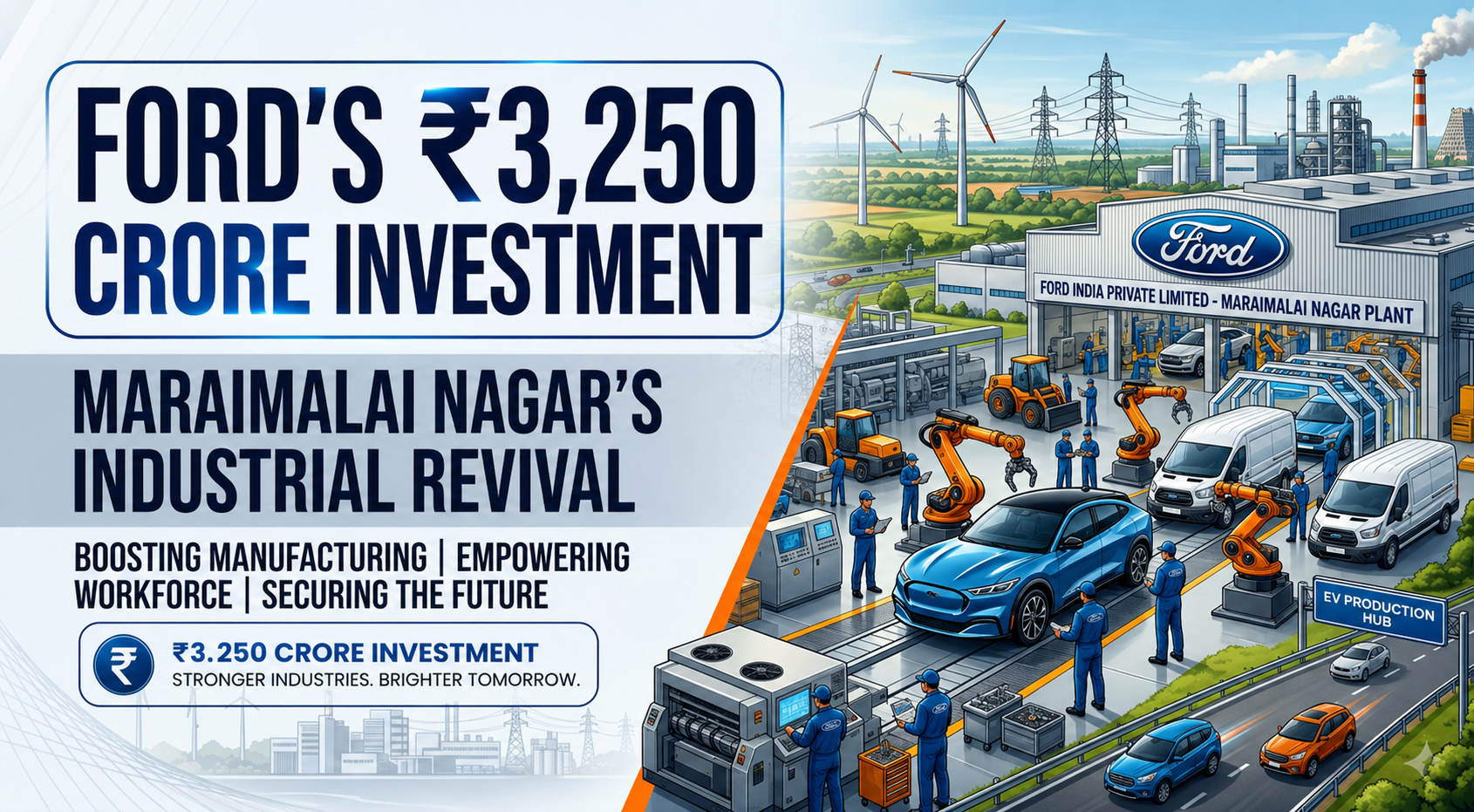

Ford Motor Company’s decision to invest ₹3,250 crore in reviving its Maraimalai Nagar plant near Chennai is more than just a corporate announcement—it’s a turning point for Tamil Nadu’s industrial ecosystem. This facility, once the heartbeat of Ford India’s operations, is set to manufacture next-generation engines with an annual capacity of 2.35 lakh units by 2029. The project promises over 600 direct jobs and countless indirect opportunities, breathing new life into a region that had slowed after Ford’s exit in 2021.
Maraimalai Nagar: A Case Study in Industrial Transformation
For years, Maraimalai Nagar was the textbook example of how one large industrial investment can shape an entire micro-market. When Ford India set up its plant, the area transformed:
- Jobs surged, attracting skilled and semi-skilled workers.
- Vendors and suppliers followed, creating a robust industrial backbone.
- Housing demand picked up, leading to residential expansion.
- Ancillary businesses—from logistics to retail—thrived.
This ecosystem was built around Ford, and when the company exited in 2021, sentiment slowed. It didn’t collapse, but it paused. The absence of a strong anchor left the micro-market waiting for its next big push.
Now, with Ford’s return, Maraimalai Nagar is once again in the spotlight. But here’s the deeper point: it’s not just about Ford coming back. It’s about what the land, infrastructure, and ecosystem represent. Large-scale industrial assets rarely stay idle forever—they get reused, repurposed, or revived. And when that happens, the surrounding micro-market moves first.
Why Maraimalai Nagar Matters
Maraimalai Nagar already has:
- An industrial backbone built over decades.
- Connectivity via GST Road, one of Tamil Nadu’s arterial routes.
- Railway access for freight and commuting.
- An existing residential base that supports industrial workers.
This means any revival here is not starting from scratch—it’s a multiplier effect on an already built system. For investors and businesses, this is where opportunities lie. In real estate, the biggest gains are rarely made when everything is obvious; they’re made when sentiment is just starting to turn. MM Nagar is at that exact point right now.
Industrial Property Management and Facility Design
Reviving a plant of this scale requires meticulous industrial property management. Utilities, compliance, workforce planning, and sustainability measures must be aligned to global standards. The Tamil Nadu government’s proactive stance on industrial approvals, including streamlined planning permits, ensures smoother execution.
Additionally, modern industrial facility design will play a crucial role. Ford’s next-generation engine plant must integrate automation, energy efficiency, and safety standards to remain competitive globally. This is not just about restarting production—it’s about future-proofing operations.
Warehouse Layout Design and Supply Chain Efficiency
Ford’s export-oriented strategy demands efficient logistics. Optimized warehouse layout design will be critical to handle components, engines, and outbound shipments. With Chennai’s proximity to ports, Maraimalai Nagar is strategically positioned to serve global markets. Smart warehouses with automation, digital tracking, and lean layouts will ensure Ford meets international demand seamlessly.
Industrial Land Dynamics in Chennai
Ford’s investment has reignited interest in industrial land for sale in Chennai. Developers, investors, and businesses are eyeing plots near Maraimalai Nagar, anticipating a surge in demand for ancillary facilities. The revival of Ford’s plant strengthens the case for industrial corridors, logistics parks, and vendor clusters in the region.
This ripple effect extends beyond Ford. Other multinational corporations may see Maraimalai Nagar as a viable location, leveraging its connectivity, workforce, and established ecosystem.
Employment and Economic Ripple Effect
The direct creation of 600 jobs is significant, but the indirect impact is even larger. Vendors, suppliers, logistics providers, and service industries will benefit from increased demand. Housing markets will see renewed activity, and local businesses—from retail to hospitality—will thrive.
This multiplier effect is what makes Maraimalai Nagar’s revival so important. It’s not just about one plant—it’s about an entire ecosystem regaining momentum.
Tamil Nadu’s Policy Advantage
Tamil Nadu has consistently positioned itself as a leader in industrial growth. Its policies emphasize ease of doing business, infrastructure development, and skill enhancement. Ford’s investment aligns perfectly with these objectives, reinforcing the state’s reputation as a manufacturing powerhouse.
The government’s focus on industrial corridors ensures that projects like Ford’s are not isolated successes but part of a larger narrative of growth.
Challenges Ahead
While the investment is promising, challenges remain. Global demand fluctuations, the shift toward electric vehicles, and geopolitical uncertainties could impact sustainability. Ford must adapt its strategies to remain competitive.
Effective construction project management will be crucial to ensure timely execution, cost control, and adherence to quality standards.
Conclusion: Maraimalai Nagar’s Turning Point
Ford’s ₹3,250 crore investment is more than a revival—it’s a catalyst. Maraimalai Nagar, once transformed by Ford’s initial entry, is now poised for a second wave of growth. With its industrial backbone, connectivity, and residential base, the region is ready to multiply its gains.
For stakeholders in industrial property management, warehouse layout design, planning permits, and industrial land for sale in Chennai, this development signals opportunity. The micro-market is turning, and those who recognize it early stand to benefit the most.
Over the next 2–3 years, Maraimalai Nagar will be a fascinating case study in industrial revival, resilience, and regional transformation.