
Introduction
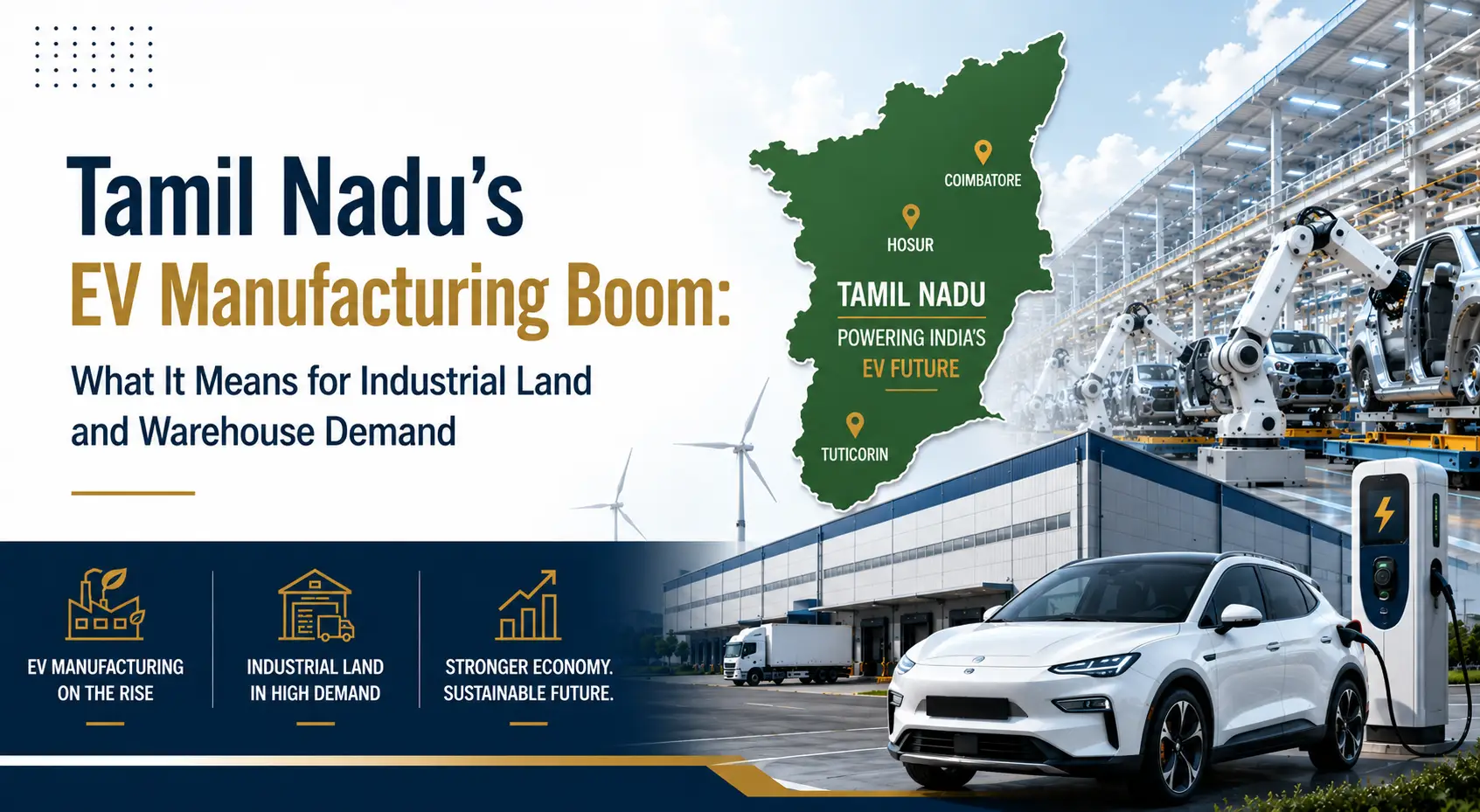
Tamil Nadu has emerged as the undisputed leader in India’s electric vehicle manufacturing landscape — and the industrial real estate market is responding accordingly.The state currently accounts for approximately 40 per cent of India’s total EV production and manufactures around 68 per cent of all electric two-wheelers sold nationally. Ola Electric, Ather Energy,TVS Motor Company, Hyundai Motor India, and a growing roster of international players have collectively committed over ₹43,000 crore in EV-related investments in Tamil Nadu, with the state targeting 35 per cent of all EV investments in India by 2030.
For manufacturers, logistics operators, and industrial real estate decision-makers, this is not a sector trend playing out in the background. It is an active demand driver reshaping where industrial land is being acquired, where warehousing is being built, and what specifications occupiers now require from industrial facilities across the Chennai–Hosur corridor.
Another major development reinforcing Tamil Nadu’s industrial growth is VinFast’s proposed ₹7000 crore investment in the state. The Vietnamese electric vehicle manufacturer has selected Tamil Nadu as its manufacturing hub for electric cars, e-scooters, and e-buses, reflecting the state’s strong automotive ecosystem, skilled workforce and investor-friendly policies.
This large-scale investment is expected to create thousands of jobs while attracting a network of Tier 1 suppliers, component manufacturers,battery producers and logistics companies to the surrounding industrial corridors. As a result, regions such as Oragadam, Sriperumbudur,Hosur are likely to witness increased demand for industrial land, factories, and warehouses. VinFast’s entry also strengthens Tamil Nadu’s position as one of India’s leading EV manufacturing destinations,further accelerating industrial real estate growth and creating new opportunities for businesses looking to establish operations in the state.
Industry Background: Tamil Nadu’s Path to EV Capital Status
Tamil Nadu’s transition from India’s automotive capital to its EV capital has been deliberate and policy-backed. The state released its first EV policy in 2019, followed by the Tamil Nadu Electric Vehicles Policy 2023, which introduced targeted incentives including capital subsidies for advanced chemistry cell (ACC) manufacturing, SGST reimbursements for EV producers, electricity tax exemptions, and EPF incentives for eligible manufacturers.
The Hosur–Krishnagiri–Dharmapuri (HKD) region, located along the NH-44 corridor between Chennai and Bengaluru, has become the anchor geography for EV production. Ola Electric’s gigafactory — among the largest EV manufacturing facilities in the world — is based here. Ather Energy operates two plants in Hosur. TVS Motor Company produces EVs from its established Hosur facility. Simple Energy and Ampere have also established manufacturing presence in the region.
Another major development reinforcing Tamil Nadu’s industrial growth is VinFast’s proposed ₹7,000 crore investment in the state. The Vietnamese electric vehicle manufacturer has selected Tamil Nadu as its manufacturing hub for electric cars,e-scooters, and e-buses, reflecting the state’s strong automotive ecosystem, skilled workforce, and investor-friendly policies. This large-scale investment is expected to create thousands of jobs while attracting a network of Tier 1 suppliers, component manufacturers,battery producers and logistics companies to the surrounding industrial corridors.
As a result, regions such as Oragadam, Sriperumbudur,and Hosur are likely to witness increased demand for industrial land, factories, and warehouses. VinFast’s entry also strengthens Tamil Nadu’s position as one of India’s leading EV manufacturing destinations, further accelerating industrial real estate growth and creating new opportunities for businesses looking to establish operations in the state
In Chennai itself, Hyundai Motor India — which has committed ₹20,000 crore to EV expansion in Tamil Nadu.
The government has also announced two dedicated EV parks at Manallur near Chennai and in Hosur, designed to house a full EV manufacturing ecosystem including OEMs, component suppliers, and battery producers within a single catchment zone.
Key Developments: Investment Scale and New Players
The scale of investment flowing into Tamil Nadu’s EV ecosystem goes well beyond the headline OEM names.
Ola Electric’s Futurefactory in Hosur, spread across 2,000 acres, has commenced production of in-house lithium-ion cells at pilot scale — making it the only entity in India to have commercially produced and deployed proprietary cells in vehicles. The Gigafactory began producing 4680-format NMC cells in late 2025, supported by the first PLI-ACC disbursement from the central government.
VinFast, the Vietnamese EV manufacturer, has signed an MoU with the Tamil Nadu government for approximately 200 hectares of land for an integrated vehicle manufacturing facility as part of a USD 2 billion committed investment.
Hyundai has publicly committed to making Tamil Nadu its flagship EV hub in India, with plans spanning localisation of components, supplier park expansion, and workforce development.
At the component level India approved ₹7280 crore to develop five domestic rare-earth magnet factories in 2025 — a direct response to supply chain dependency risks.Tamil Nadu’s established manufacturing base makes it a natural location candidate for this upstream investment as it scales.
Market Impact Analysis: Industrial Real Estate Implications
Factory for Rent and Sale Demand Along the Hosur–Chennai Corridor
The EV manufacturing expansion has created sustained, large-format demand for industrial facilities along the NH-44 belt. This corridor — running from Hosur through Krishnagiri toward Chennai — is now one of the most actively leased industrial geographies in South India.
Demand is coming from two distinct occupier types. First, the anchor OEMs and gigafactory operators who require large built-to-suit facilities with very specific technical specifications — high-capacity power, ESD-safe manufacturing zones, dust-free assembly environments, and integrated battery storage compliance. Second, the Tier 1 and Tier 2 component suppliers who cluster around these anchor facilities and require factory for rent options that can be activated quickly as production ramp-ups accelerate.
Both categories are tightening available supply along the core Hosur belt, pushing enquiries further toward the Krishnagiri and Dharmapuri sub-corridors where new SIPCOT land parcels remain available.
Industrial Land for Sale in Chennai: The EV Supplier Park Effect
The supplier park model — where component manufacturers co-locate within or adjacent to OEM facilities — is creating a distinct type of industrial land demand in Tamil Nadu. Industrial land for sale in Chennai’s western and southern corridors is attracting EV-linked component manufacturers who need to be within a defined logistics radius of their anchor customers.
Sriperumbudur, which already houses electronics and automotive component manufacturers, is seeing fresh enquiries from EV-adjacent sectors: battery management system manufacturers, wiring harness producers, thermal management component suppliers, and EV charging infrastructure assemblers. This demand is additive to the existing industrial base — it sits on top of the automotive and electronics ecosystem already in place.
Warehouse Demand: Battery Logistics and Cold Chain Requirements
The battery supply chain introduces warehousing requirements that differ significantly from conventional automotive parts logistics. Lithium-ion cells and battery packs require temperature-controlled storage, specialised fire suppression systems, and handling protocols that most legacy industrial shed stock cannot accommodate.
This has created demand for purpose-built industrial shed for rent in Chennai and the Hosur belt with EV-compliant specifications. Operators in battery import, distribution, and pack assembly are actively seeking facilities that meet hazardous materials storage norms, with access to high-capacity power and proximity to OEM plants.
Since 2021,Chennai alone has seen nearly 20 million sq ft of industrial and warehousing leasing activity. Q1 2025 recorded Grade-A space absorption of 2 million sq ft — approximately three times that of the previous quarter — with EV and electronics sectors cited as key demand drivers alongside 3PL companies.
For Investors: Industrial Plot for Sale Opportunities in EV-Adjacent Zones
Industrial plot for sale options near established EV manufacturing clusters — particularly in Hosur, Krishnagiri, and the developing Manallur EV park near Chennai — are attracting investor interest from both institutional funds and strategic buyers.The pattern is consistent with how India’s electronics cluster in Sriperumbudur developed. Anchor investment created a gravitational pull for supply chain participants, which in turn drove sustained demand for industrial land, resulting in multi-year land value appreciation in well-located plots with correct zoning and infrastructure.
Investors evaluating factory for sale or industrial plot for sale positions in EV-proximate zones should prioritise parcels with confirmed industrial zoning, reliable HT power access, road connectivity to the national highway, and proximity to SIPCOT-notified zones.
Future Outlook: What the Next Phase Looks Like
The next phase of Tamil Nadu’s EV industrial build-out will be driven by three converging trends.
First, cell and battery manufacturing scale-up. India’s PLI-ACC scheme is pushing cell manufacturing capacity from pilot to commercial scale. Tamil Nadu, as the home of Ola Electric’s Gigafactory and a policy environment specifically incentivising ACC investment, will attract a disproportionate share of this activity. The industrial land and warehousing requirements for cell manufacturing are larger and more technically demanding than vehicle assembly.
Second, EV export infrastructure. Tamil Nadu’s four seaports and the planned cargo terminal at Parandur Greenfield Airport position the state to become a significant EV export base. Logistics and warehousing infrastructure between production clusters and export points will need to expand to support this throughput.
Third, second-life battery and EV recycling. As the first generation of EVs ages, battery recycling and refurbishment will generate a new industrial occupier category. Facilities with chemical handling compliance, waste management infrastructure, and buffer zones will be in demand.
Grade-A industrial and warehousing rents across Chennai and Hosur corridors have recorded steady annual appreciation of 4–6 per cent over recent years, with select corridors seeing 5–10 per cent rental growth in tighter micro-markets. This trajectory is expected to continue as EV-linked demand adds a structurally new layer of occupier activity to a market that was already undersupplied in compliant stock.
Conclusion
Tamil Nadu’s EV manufacturing boom is not a single-sector story — it is a demand catalyst that is reshaping the state’s entire industrial real estate geography. From large-format built-to-suit facilities for OEMs in Hosur to supplier park clusters near Sriperumbudur, from battery-compliant warehousing on the GST Road corridor to industrial plot for sale positions near upcoming EV parks, the implications span every category of industrial occupier and investor.
Companies evaluating factory for rent in Chennai or industrial land for sale in Chennai as part of EV supply chain positioning should be conducting location assessments now. The supply of EV-compliant industrial stock is limited, and the demand is accelerating.
AllWarehouses.in lists verified industrial properties, factories, warehousing facilities, and industrial land across Chennai’s EV and manufacturing corridors — including Sriperumbudur, Oragadam, and the Hosur belt.
Frequently Asked Questions
1. Which locations in Tamil Nadu are seeing the most EV-linked industrial demand? The Hosur–Krishnagiri belt and the Sriperumbudur–Oragadam corridor are the primary demand zones. Hosur anchors OEM and gigafactory activity, while Sriperumbudur attracts EV component and electronics supply chain occupiers.
2. What makes industrial shed demand from EV companies different from conventional manufacturing? EV-related occupiers require facilities with high-capacity power connections, ESD-safe environments, battery-compliant storage with fire suppression systems, and dust-free assembly zones. Legacy SIDCO or CMDA shed stock typically cannot meet these specifications without significant capital upgrade.
3. Is industrial land for sale in Chennai near EV clusters still available? Available parcels exist but are tightening, particularly near SIPCOT-notified zones in Sriperumbudur and the Manallur EV park catchment near Chennai. Buyers should verify zoning, power availability, and road access before committing.
4. What is driving battery logistics warehouse demand in Tamil Nadu? Cell and battery pack distribution requires temperature control, hazardous materials compliance, and high-capacity power — specifications that most conventional warehouse stock does not offer. This is creating demand for purpose-built industrial warehousing along the NH-44 and GST Road corridors.
5. How is Tamil Nadu’s EV policy supporting industrial real estate investment? The Tamil Nadu EV Policy 2023 offers SGST reimbursements, capital subsidies for ACC manufacturing, electricity tax exemptions, and EPF incentives — all of which reduce operating costs for EV manufacturers and make Tamil Nadu a more competitive location choice versus other states.
Key Takeaways
- Tamil Nadu produces 40% of India’s EVs and 68% of all electric two-wheelers, anchored by Ola, Ather, TVS, and Hyundai — making it the dominant EV manufacturing state in India.
- EV-linked industrial land demand is additive. It layers on top of the existing automotive and electronics base in clusters like Sriperumbudur and Oragadam, tightening available industrial land for sale in Chennai across both sectors simultaneously.
- Battery logistics is a new warehouse demand category that requires compliant, purpose-built facilities — not legacy stock. This gap between occupier requirements and available supply is creating a development opportunity in Tamil Nadu’s industrial real estate market.
- The Hosur–Chennai corridor is the spine of this growth. Industrial plot for sale positions along NH-44 and within SIPCOT-notified zones in this belt are among the most strategically positioned in South India for EV supply chain investment.
Factory for rent demand will remain elevated. As OEM production ramps accelerate and supplier park formation follows, the demand for lease-first, Grade-A manufacturing space along the Hosur belt and Chennai’s western corridor will continue to outpace supply.