
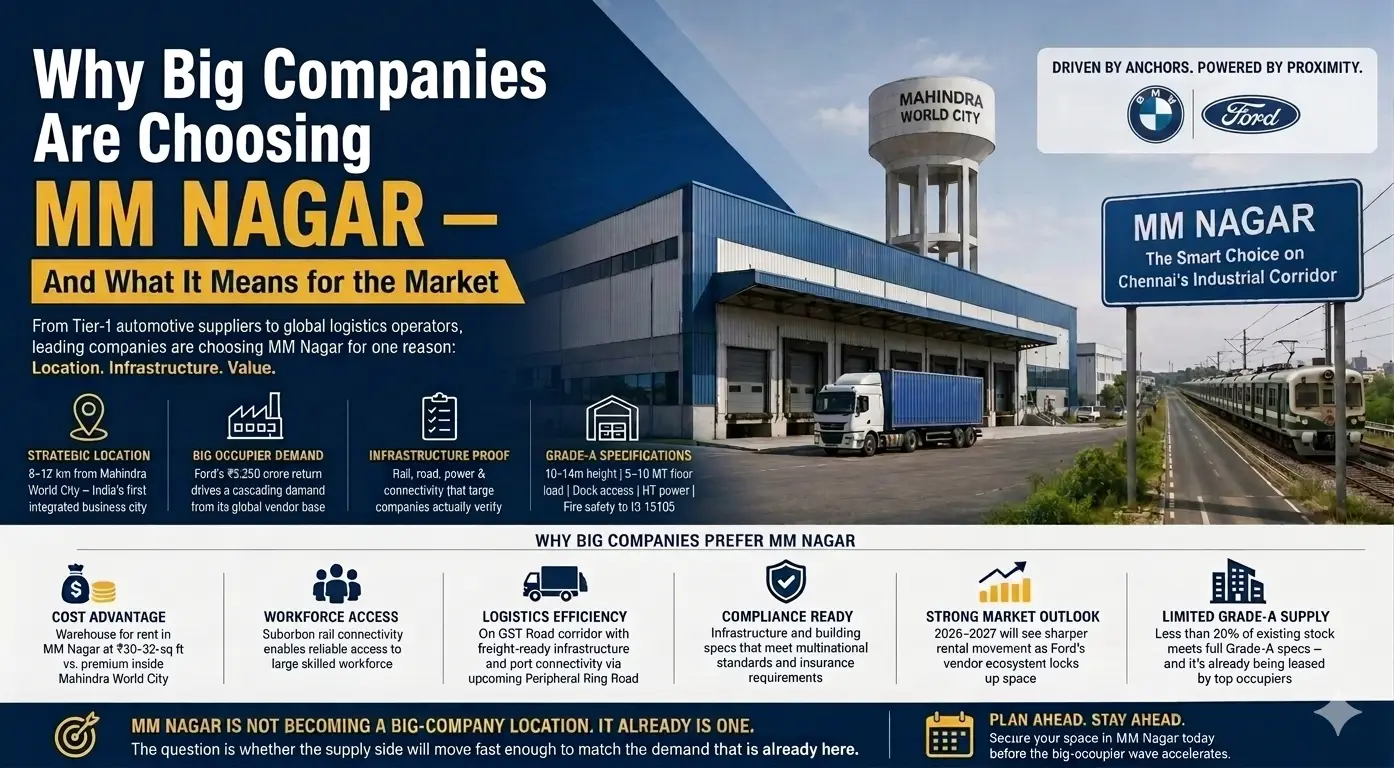
There is a shift happening quietly along Chennai’s southern industrial corridor. The companies now signing leases for industrial spaces in Maraimalai Nagar are not small MSME units looking for a cheap godown. They are Tier-1 automotive suppliers, multinational logistics operators, large FMCG manufacturers, and precision engineering firms with global procurement contracts. MM Nagar, once known primarily as a SIDCO small-industries belt, is now attracting big occupiers — and understanding why reveals a great deal about where this micro-market is heading.
The Mahindra World City Pull — Why Location Drives Big Occupier Decisions
Large companies do not choose industrial locations randomly. They run total-cost-of-occupation models that factor in logistics costs, workforce access, proximity to anchor customers, and infrastructure reliability. MM Nagar scores exceptionally well on all four.
Mahindra World City — India’s first integrated business city, spread across 1,500+ acres in Chengalpet district — sits 8–12 km from MM Nagar’s core industrial belt. It houses BMW India’s assembly plant, Saint-Gobain, Renault, and over 150 companies employing 38,000+ people. Every one of those companies generates supplier, vendor, and logistics demand that cannot be served from inside Mahindra World City itself — land inside is fully allocated and priced accordingly. The demand spills outward into the 10–15 km radius. MM Nagar sits directly in that zone.
For a Tier-1 automotive supplier, the ability to deliver intra-day components to an OEM assembly line from a warehouse for rent in MM Nagar- while paying Rs. 30–32 per sq ft instead of Mahindra World City’s internal land premium- is a straightforward commercial decision.
Ford’s Return -The Catalyst That Changes the Occupier Profile
Ford India’s confirmed ₹3,250 crore return to the Maraimalai Nagar-Chengalpet corridor is not just a headline. It is a demand event. When a global automotive OEM reactivates a major plant, it triggers a cascading requirement from its vendor base-Tier-1, Tier-2, and Tier-3 suppliers who need to be close enough to supply the assembly line reliably.
These are not small operations. Ford’s vendor supply chain at scale involves precision component manufacturers, stamping and fabrication units, electronic systems suppliers, paint and chemicals firms, and finished goods logistics operators. Each of them needs industrial space- factories for rent, industrial sheds for rent, warehouse for rent- within commuting logistics distance of the Ford plant. MM Nagar is the most naturally positioned micro-market to absorb that demand.
The 2026–2027 window, when Ford’s vendor network begins actively locking up space, will likely change the pricing and availability picture in MM Nagar significantly. Big companies that are moving now are doing so precisely to get ahead of that wave.
The Infrastructure Proof -What Big Occupiers Actually Verify
Large companies do not sign leases on faith. Before committing to industrial spaces for rent, their procurement and facilities teams verify infrastructure against a checklist that smaller occupiers sometimes skip.
MM Nagar passes that checklist in ways that competing micro-markets do not always match:
The suburban railway station at Maraimalai Nagar provides direct city connectivity-critical for workforce commuting at scale when a company employs hundreds of production workers. The GST Road corridor is one of Tamil Nadu’s most freight-capable arterial routes, with TNEB infrastructure already built for HT industrial power connections that large manufacturing tenants require. The Chennai Peripheral Ring Road, once complete, will cut port-to-plant logistics time- a significant factor for import-dependent manufacturers and export-oriented production units.
For a multinational evaluating its Tamil Nadu supply chain footprint, these infrastructure credentials matter. They are the difference between a location that works on paper and one that works in operation.
The Specification Upgrade – Why Grade-A Supply Is Attracting Bigger Tenants
Big companies have non-negotiable building specifications. A 5-metre clear height SIDCO shed that works fine for a small fabrication unit does not work for a modern automotive components plant running overhead cranes, or for a 3PL logistics operator managing palletised high-bay storage.
The emergence of Grade-A industrial supply in MM Nagar — offering 10–14 metre clear heights, 5–10 MT floor load capacity, dock leveller access, HT power with DG backup, and fire suppression to IS 15105 standards — is what has unlocked large occupier demand. These specifications match what multinationals and large domestic manufacturers require, and their insurance carriers and compliance teams mandate.
Less than 20% of MM Nagar’s existing stock meets full Grade-A specification. But where it exists, it is being leased by exactly the class of occupier that drives rental rates upward and lease terms longer. The Rs. 30–32 per sq ft rate for Grade-A warehouse for rent in MM Nagar reflects genuine large-occupier demand — not speculative pricing.
The Competitive Edge Over Other Spillover Markets
Guduvancherry attracts attention as the closest Mahindra World City spillover zone — but land prices there have already priced in much of the spillover story. Chengalpet is further south, adding logistics distance to the daily operational equation. Oragadam and Sriperumbudur, further north and west, serve a different anchor ecosystem and lack MM Nagar’s suburban rail connectivity.
MM Nagar’s combination of Mahindra World City proximity, suburban rail access, established SIDCO industrial identity, HT power infrastructure, and still-competitive land pricing is what big occupiers — running disciplined site selection processes — keep arriving at. It is not that MM Nagar is being discovered. It is that serious occupiers doing serious analysis keep reaching the same conclusion.
What This Means If You Are in the Market Now
If you are a supplier or logistics operator evaluating industrial spaces for rent in the GST Road corridor, the window to get ahead of the big-occupier wave is now. Once Ford’s vendor ecosystem begins locking up space in 2026–2027, available Grade-A industrial sheds for rent in MM Nagar at current rates will be scarce.
If you are a landlord or developer, the big-occupier demand signal is telling you exactly what to build and to what specification. The tenants are there. The demand is real. The infrastructure is already in place. What the market needs is more Grade-A supply built to the specification those tenants will actually sign a long-term lease for.
MM Nagar is not becoming a big-company location. It already is one. The question is whether the supply side will move fast enough to match the demand that is already there.